Antipodes: Where You Would Come Out
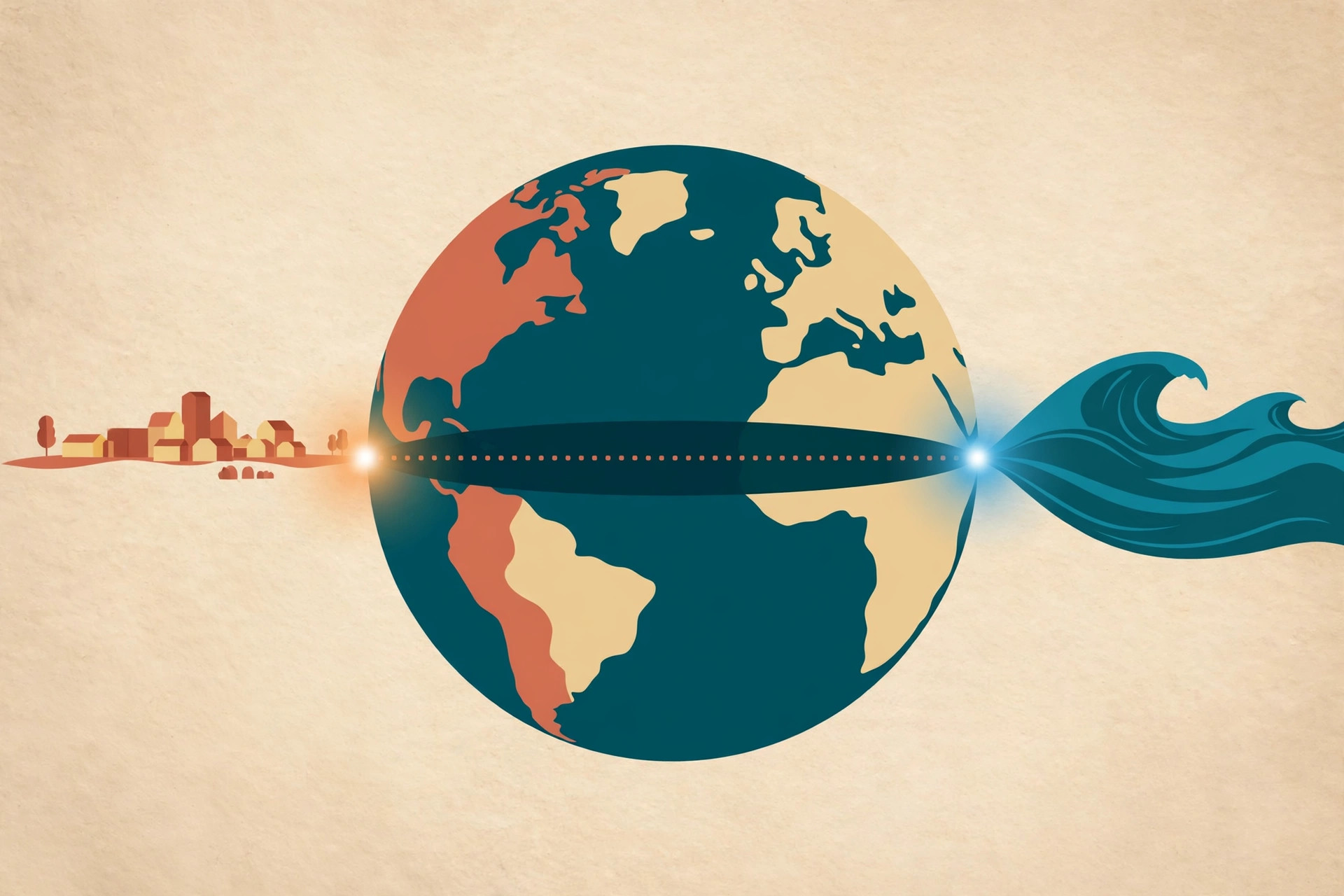
The point exactly opposite
The antipode of a place is the point on the surface directly opposite it, as far away as it is possible to be while staying on the planet. Finding it is simple geometry: flip the latitude from north to south or the reverse, and move the longitude by exactly 180 degrees. The distance between a place and its antipode, measured along the surface, is half the circumference of the Earth, about 20,000 kilometres, and the straight line through the middle is the full diameter, roughly 12,742 kilometres. Every place has exactly one antipode, and the relationship always works both ways.The idea works for any sphere, and the same calculation locates the antipode of a point on the Moon or Mars, where landing sites are sometimes described by the places that lie opposite them on the globe.
Why you would probably get wet
Oceans cover about 71 percent of the surface, and land is not spread evenly, so most antipodes are at sea. Start in Britain and you surface in the Pacific south east of New Zealand. Start in most of North America and you land in the Indian Ocean. Children in the United States were long told they would dig to China, but the true opposite of the continental United States is open ocean; it is Argentina and Chile that face China across the globe. Only about 15 percent of land has land on the far side, which makes the genuine pairs feel like curiosities.A favourite classroom exercise is the antipodes map, two world maps overlaid with one of them flipped, which reveals the few land overlaps at a glance and starts arguments about almost every coastline in the atlas.
The famous land to land pairs
The best known pair is Spain and New Zealand: Madrid faces a point in the Pacific just east of the North Island, and parts of southern Spain face New Zealand land itself. Ecuador and Indonesia face each other, as do parts of Brazil and the Philippines. These coincidences delight map lovers because they are so rare. The idea is ancient: the word antipodes comes from Greek for opposite feet, and medieval scholars argued about whether people could live on the far side of the world without falling off, a debate that says more about their picture of gravity than about geography.New Zealand embraces the connection: the Antipodes Islands, a real subantarctic group south east of Stewart Island, earned their name from lying close to the opposite side of the world from London and Greenwich.