The Continents in Perspective
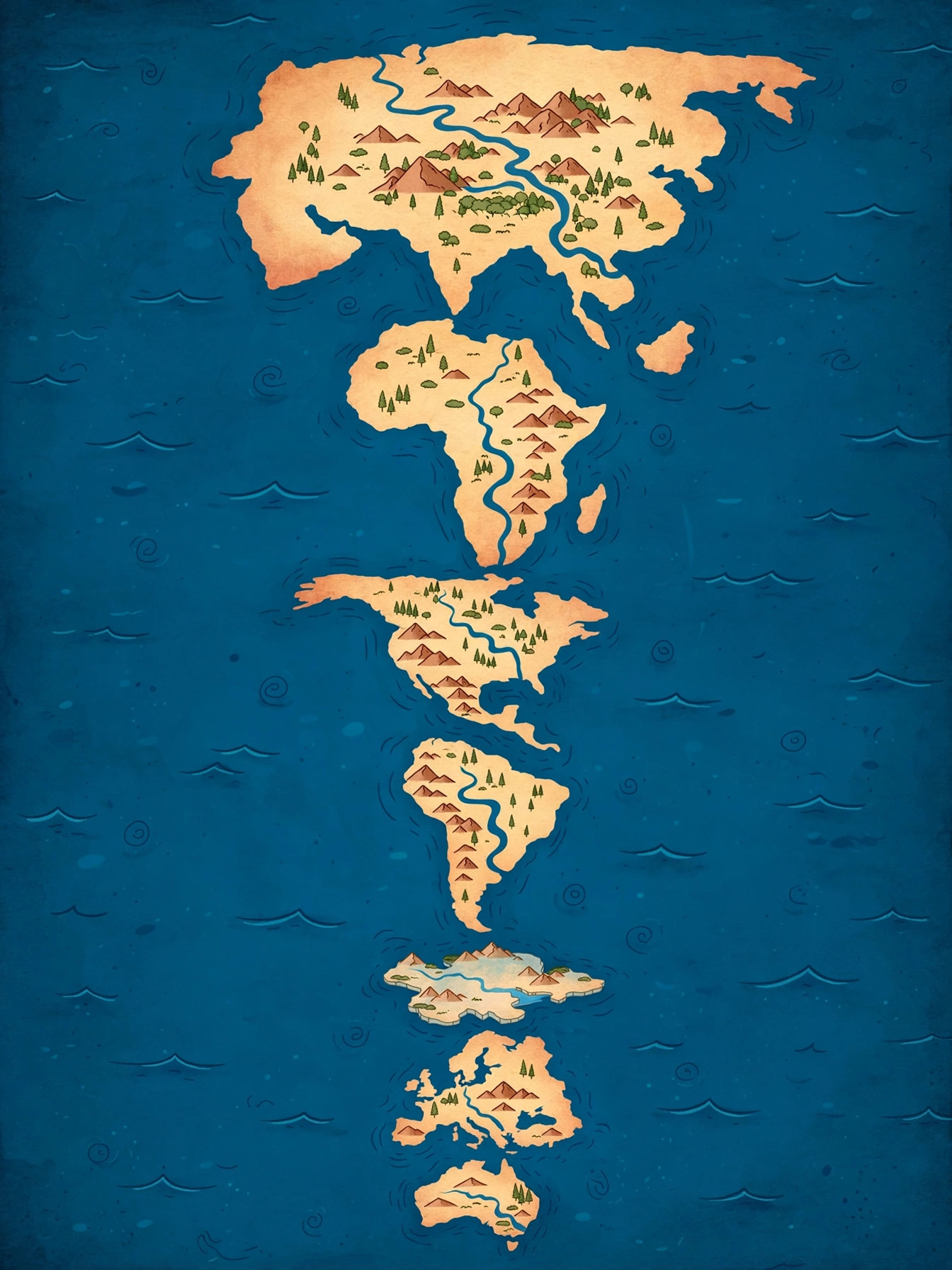
Counting continents is a human habit
Ask how many continents there are and the answer depends on where you went to school. Much of the English speaking world learns seven; many European and Latin American schools teach six, counting the Americas as one or Eurasia as one; some schemes give five inhabited continents. The disagreement is honest, because continents are conventions layered on geology. Europe and Asia share one continuous landmass and one tectonic story in large part, yet history and culture keep them apart on the list. Any ranking of continent sizes therefore carries a footnote about which scheme it follows.Schoolchildren in different countries draw the world differently because of these schemes, and comparing atlases across borders is a gentle lesson in how much of geography is agreement.
The sizes, with the usual scheme
By the seven continent scheme, Asia is the giant at about 44.6 million square kilometres, over a quarter of all land, followed by Africa at about 30.3 million, North America at about 24.7 million, South America at about 17.8 million, Antarctica at about 14 million under its ice, Europe at about 10 million, and Australia at about 7.7 million as the smallest true continent. Asia alone is larger than the moon surface facing comparisons suggest, and Africa could hold the United States, China, India and most of Europe with room to spare, a fact the true size maps make visceral.Australia claims the title of the largest island and the smallest continent simultaneously only by convention: geologically it is a continent, and Greenland takes the island crown it would otherwise hold.
The continent that mostly drowned
Geologists have lately made the case for an eighth: Zealandia, a slab of continental crust about 4.9 million square kilometres in extent, over 90 percent of it beneath the Pacific, with New Zealand and New Caledonia as its high ground. It meets the technical tests of continental crust, thickness and separation from Australia. Whether atlases adopt it will be decided by usage, not by the rocks, which are indifferent. The episode is a tidy summary of the whole topic: the land is what it is, and the categories are ours, useful exactly as long as we remember we made them.The areas quoted here count land including major inland waters in the usual published way; shift the convention and the numbers move slightly, while the order of the giants stays put.