Crossing the Equator
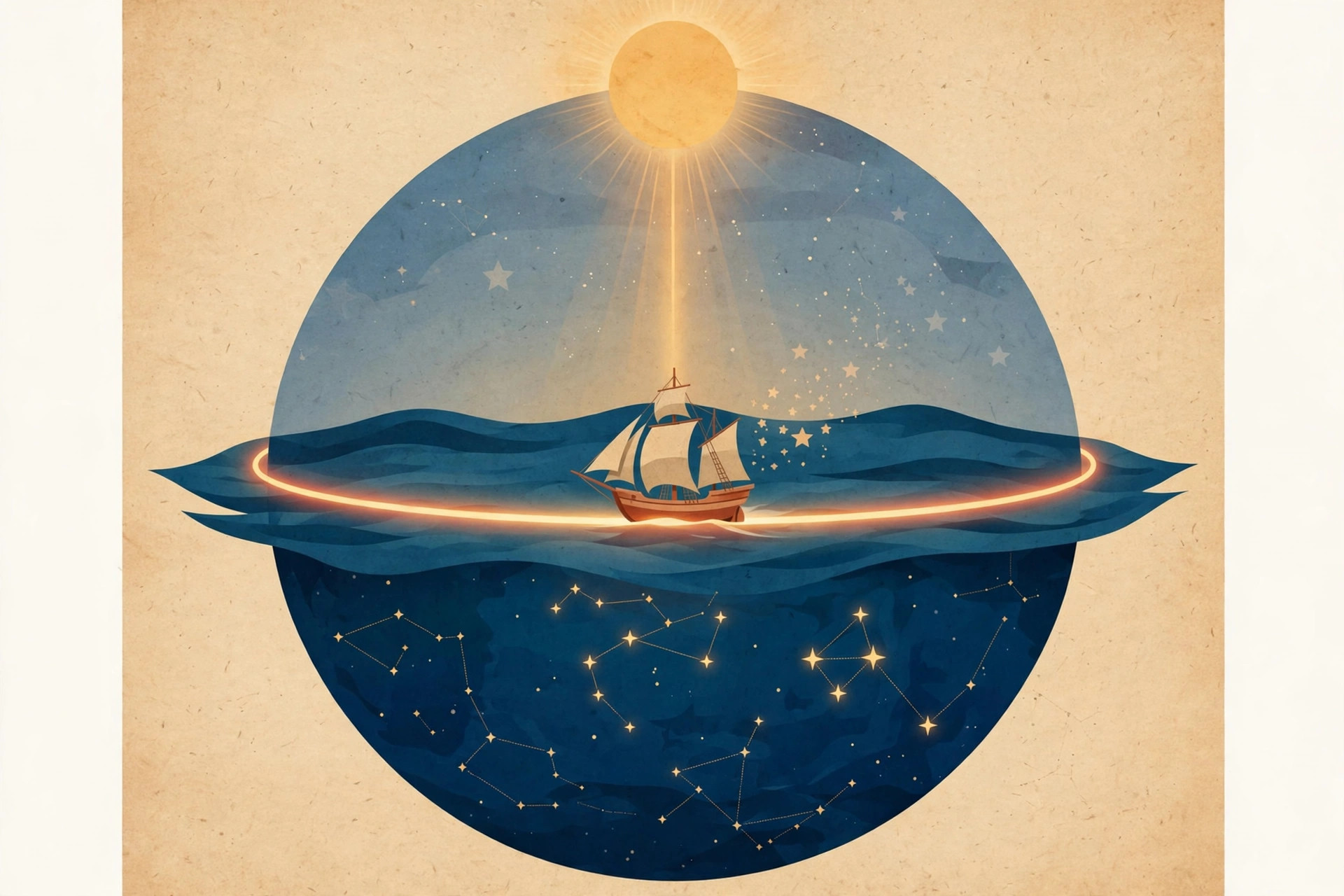
The line you cannot see
The equator is the only parallel that is also a great circle, the waistline of the planet at latitude zero, dividing the hemispheres and carrying the longest circumference of any line on the surface. Fourteen countries have land on it, from Ecuador, which named itself after it, to Indonesia and Kenya. Monuments stand where roads cross it, and tourists pose with a foot in each hemisphere, though the true line by modern survey often runs a few hundred metres from the painted one, because the older surveys were good but not satellite good.Navies still hold the ceremony for first time crossers, with Neptune court and costumes, one of the oldest rituals of the sea surviving intact into the age of container ships.
Climate at zero latitude
At the equator the sun passes nearly overhead twice a year, day and night stay within minutes of twelve hours in every month, and the seasons are marked by rain rather than temperature. The belt of rising air along the equator feeds the great rainforests of the Amazon, the Congo and south east Asia, and the doldrums, the calm zone that becalmed sailing ships for weeks. Hurricanes cannot form within about five degrees of the line, because the Coriolis effect that spins them vanishes at zero latitude, one of the few places where the physics of the turning Earth can be felt as an absence.Equatorial countries market the line honestly and otherwise: the true line by GPS often runs through a field near the grand monument, and the better sites now tell you so.
Odd effects at the line
Water draining from a basin does not reliably swirl opposite ways either side of the line, whatever the roadside demonstrations claim; the effect is far too weak against the shape of the basin. What is real is subtler: you weigh slightly less at the equator than at the poles, because you are further from the centre of the Earth and the spin flings you gently outward, a difference of about half a percent that precision scales can detect. Rockets launch eastward from near the equator to borrow the full speed of the spin, which is why the European spaceport sits in French Guiana, close to the line and over open sea.Standing at zero latitude completes a set with the prime meridian and the poles: the handful of places where the grid itself is the attraction.