Greenwich and the Prime Meridian
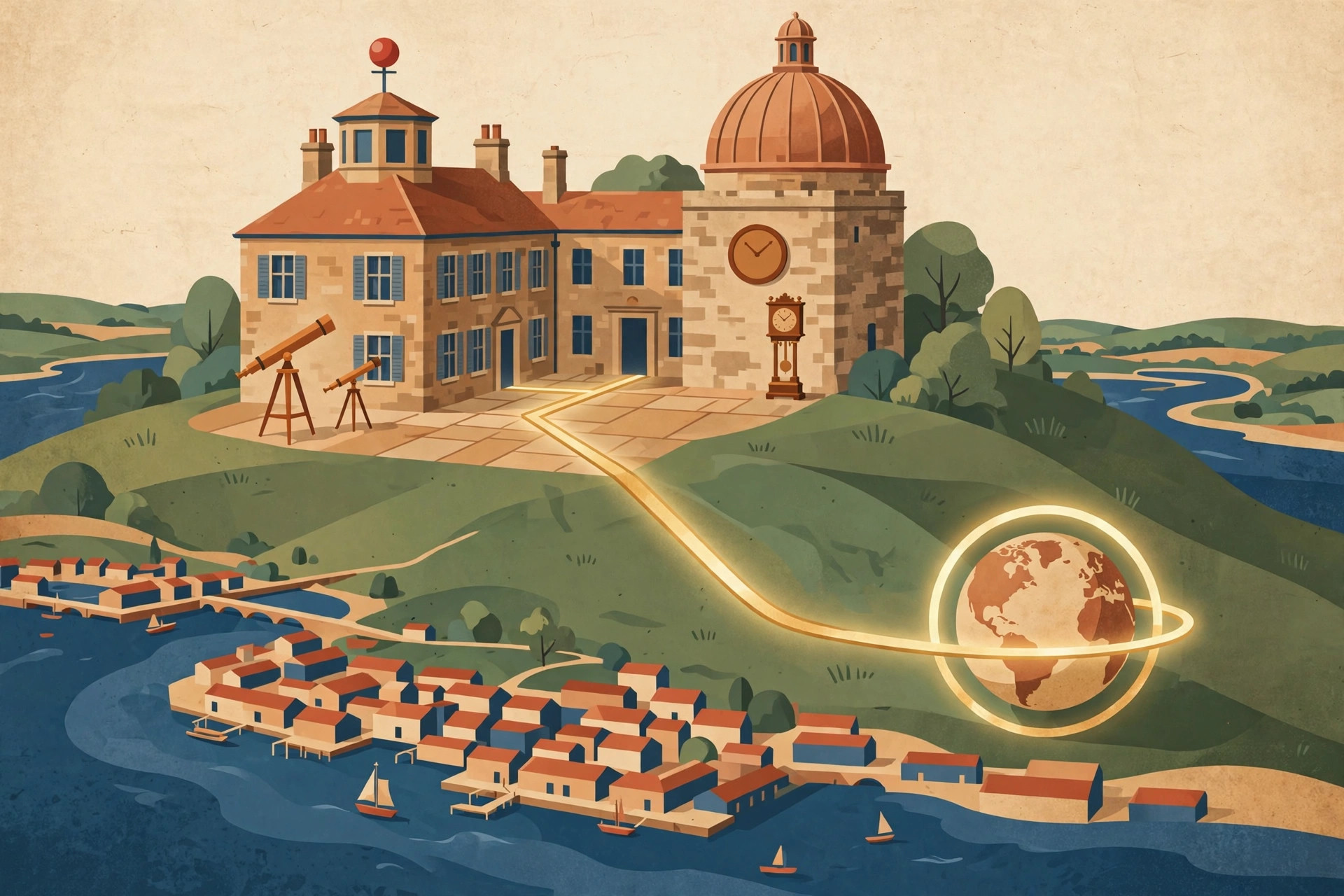
A working observatory
The Royal Observatory at Greenwich was founded in 1675 to solve a practical problem: sailors needed accurate star tables and time to find their longitude at sea. Its astronomers published the data, its clocks set the standard, and from 1880 Greenwich Mean Time was the legal time of Britain. When the world met in Washington in 1884 to choose a prime meridian, Greenwich won with 22 votes to 1, helped by the unglamorous fact that most of the world shipping already navigated on British charts and most telegraph networks already distributed Greenwich time.The observatory time ball, dropped daily at one o clock so ships in the Thames could rate their chronometers, still falls today, a working fossil of the system that timed the world.
GMT, UTC and the modern zero
GMT began as the mean solar time at Greenwich, averaged over the wobble of the real sun. Modern life runs on UTC, Coordinated Universal Time, kept by atomic clocks and adjusted with leap seconds to stay close to the turning Earth. For everyday purposes the two agree to the second, and time zone offsets are quoted from UTC. The meridian itself has also quietly moved: the modern reference meridian used by GPS passes about 102 metres east of the old telescope line, because it is defined by the whole network of satellites and stations, not by one instrument on a hill.Longitude zero also anchors the world magnetic and mapping models, so a hiker in any country is, in a sense, measuring from that London hill every time a phone reports a position.
Standing on the line
Visitors still queue to stand with a foot in each hemisphere in the observatory courtyard, and the brass strip there is a fine photo and a small fiction, off by those hundred metres from the coordinate zero your phone reports. The discrepancy is a good lesson in what coordinates are: not marks on the ground but agreements, maintained by institutions, that everyone uses the same numbers. The longitude time calculator on this site works from the modern agreement, counting solar time from longitude zero exactly as your phone does.France consoled itself with the Paris meridian in art and fiction for decades, and the rivalry survives as a brass line of medallions across Paris that tourists still follow through the streets. The hill is now a museum, but the meridian line in its courtyard still does daily duty as the most photographed coordinate on Earth.