How Map Scales Work
A ratio, not a measurement
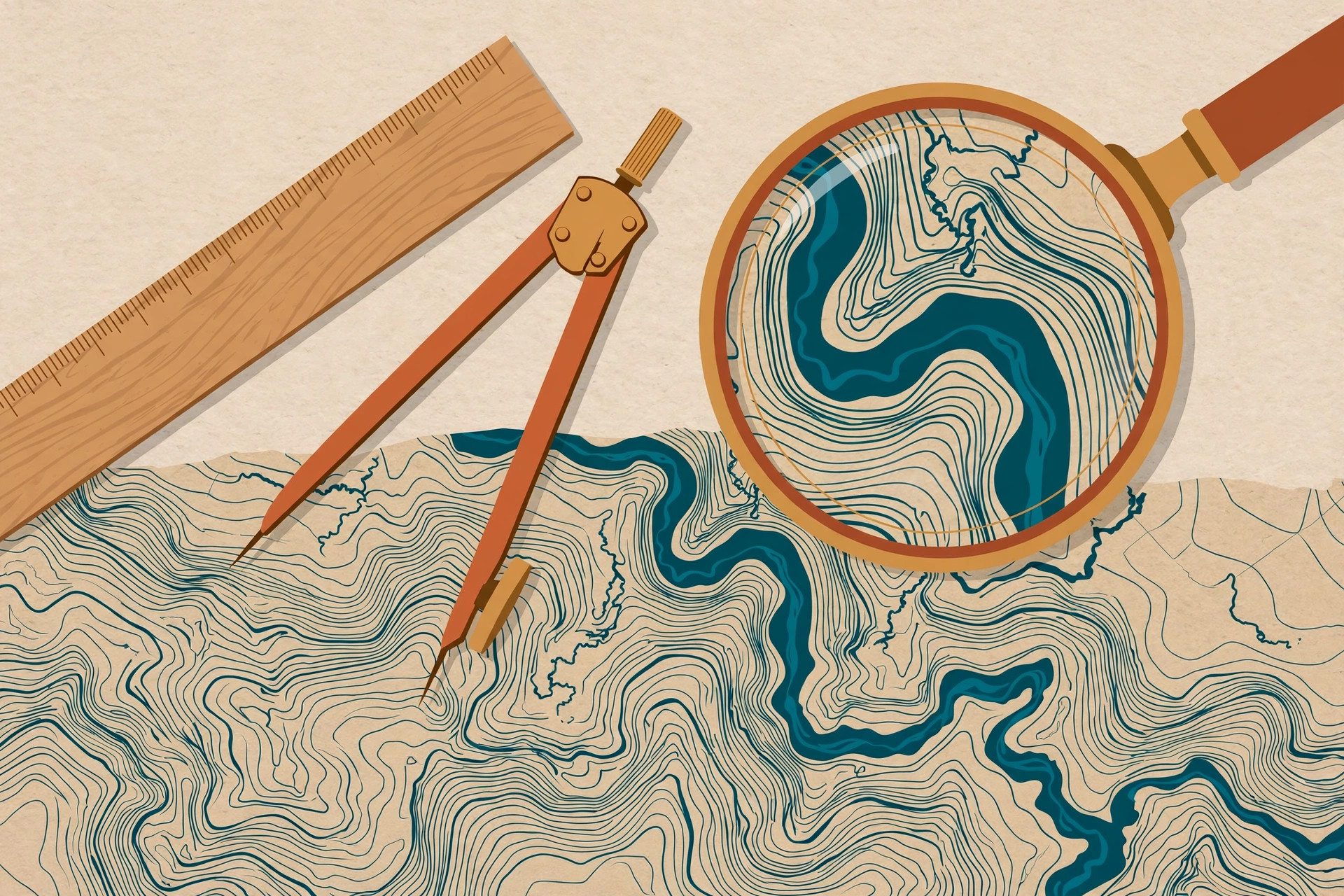
A map scale such as 1:50,000 is a ratio between the map and the ground. One centimetre on the paper represents 50,000 centimetres on the Earth, which is 500 metres. The same ratio works in any unit: one inch stands for 50,000 inches. Because it is unit free, the scale stays true whatever ruler you pick up. What breaks it is resizing: print the map larger, photograph it, or view a screenshot, and the ratio quietly changes, which is why digital maps carry a scale bar that redraws itself instead of trusting a printed number.A bar scale drawn on the map solves the resizing problem elegantly, because the bar stretches or shrinks with the image, so the ground distance it represents stays true at any size.
Big scale, small scale, endless confusion
Cartographers call 1:25,000 a large scale map and 1:1,000,000 a small scale map, which feels backwards until you treat the scale as a fraction. One twenty five thousandth is a bigger fraction than one millionth, so the large scale map shows a smaller area in greater detail: individual field boundaries, footpaths and contour lines. The small scale map covers a country at a glance but can show only motorways and cities. Walkers buy large scale, planners of road trips buy small scale, and the phrase large scale refers to the detail, never to the size of the paper.The ratio also explains why one map cannot serve every purpose: a sheet that shows a whole county cannot show your street, and the sheet that shows your street cannot show the county, so atlases are ladders of scales.
Choosing a scale for the job
Match the scale to the decision. At 1:50,000, the standard for many national hiking series, a centimetre is half a kilometre and a day walk fits on one sheet. At 1:10,000, used for town plans, a centimetre is 100 metres and individual buildings take shape. Globe makers work near 1:40,000,000, where a centimetre holds 400 kilometres and whole countries become shapes to recognise rather than places to navigate. The scale calculator on this site converts in both directions, from a measurement on the map to the ground, and from a planned journey to the length it will occupy on your sheet.Walkers develop a feel for their favourite scale until distances become instinct: at 1:25,000 a thumb width is roughly a kilometre, a calibration old hands check against the scale bar before every walk.