Island Nations and the Sea Around Them
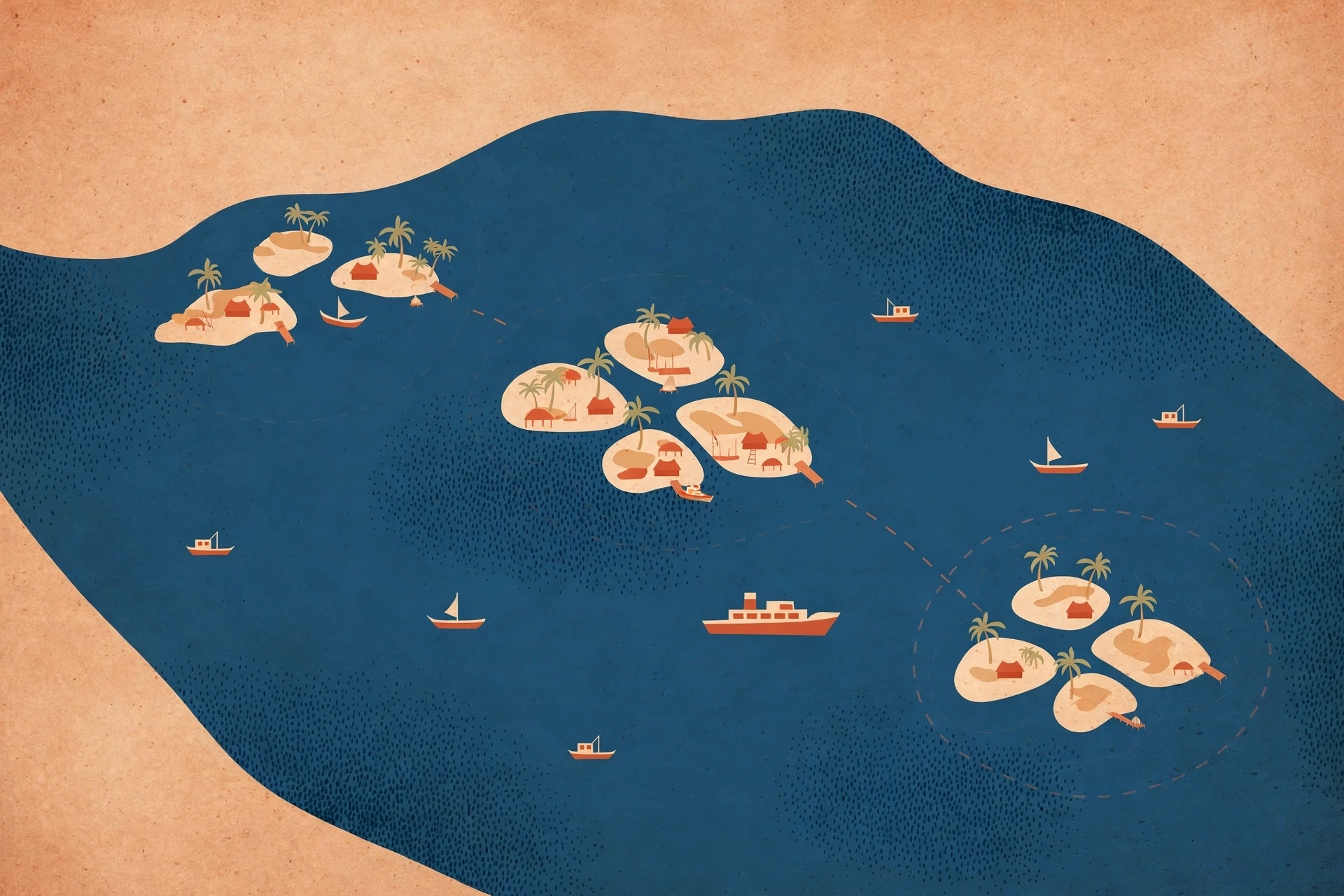
A world of islands
Depending on how you count, the world has well over two thousand inhabited islands, and a handful of states made entirely of them: Indonesia counts some seventeen thousand islands in its archipelago, the Philippines about seven and a half thousand, and Japan nearly fifteen thousand by its modern digital recount. Island geography is governed by one master variable, distance from the nearest continent. Near islands share the wildlife and weather of the mainland; remote islands evolve strange species, depend on the sea for everything, and feel every change in shipping costs in the price of bread.Island capitals are almost always ports, and island politics is often the politics of a harbour: who dredges it, who supplies it, and what the ferry costs in winter.
What the surrounding sea does
The ocean is a thermostat. Water heats and cools slowly, so islands have mild winters and cool summers for their latitude, small daily temperature swings and long growing seasons, the maritime climate that lets palm trees surprise visitors in the Scilly Isles at the latitude of Canada frozen bays. The sea is also a wall and a road at once: it isolates ecologies until they become unique, then connects ports to everywhere. For low coral atolls, the sea is an existential question, with the highest land in the Maldives under two and a half metres and freshwater stored in a lens floating on salt water beneath the sand.The isolation cuts both ways in a crisis: islands can close a border with a harbour chain, yet depend on the same sea for fuel and food within weeks, a bargain every island government understands.
Measuring the gaps
Everything about an island strategy reduces to distances: to the mainland, to the nearest port, to the next island in the chain. Those are great circle questions, and the answers explain ferry timetables, flight networks and why some islands feel like suburbs of a continent while others feel like ships that never dock. The distance tools on this site work happily between island coordinates; try your favourite capital against its nearest continental port and the number will tell you more about the place than a page of description.For the traveller, islands reward the distance mindset: the gap you cross to reach one is not dead time but the moat that kept the place itself.