Map Projections: Why Every Flat Map Distorts
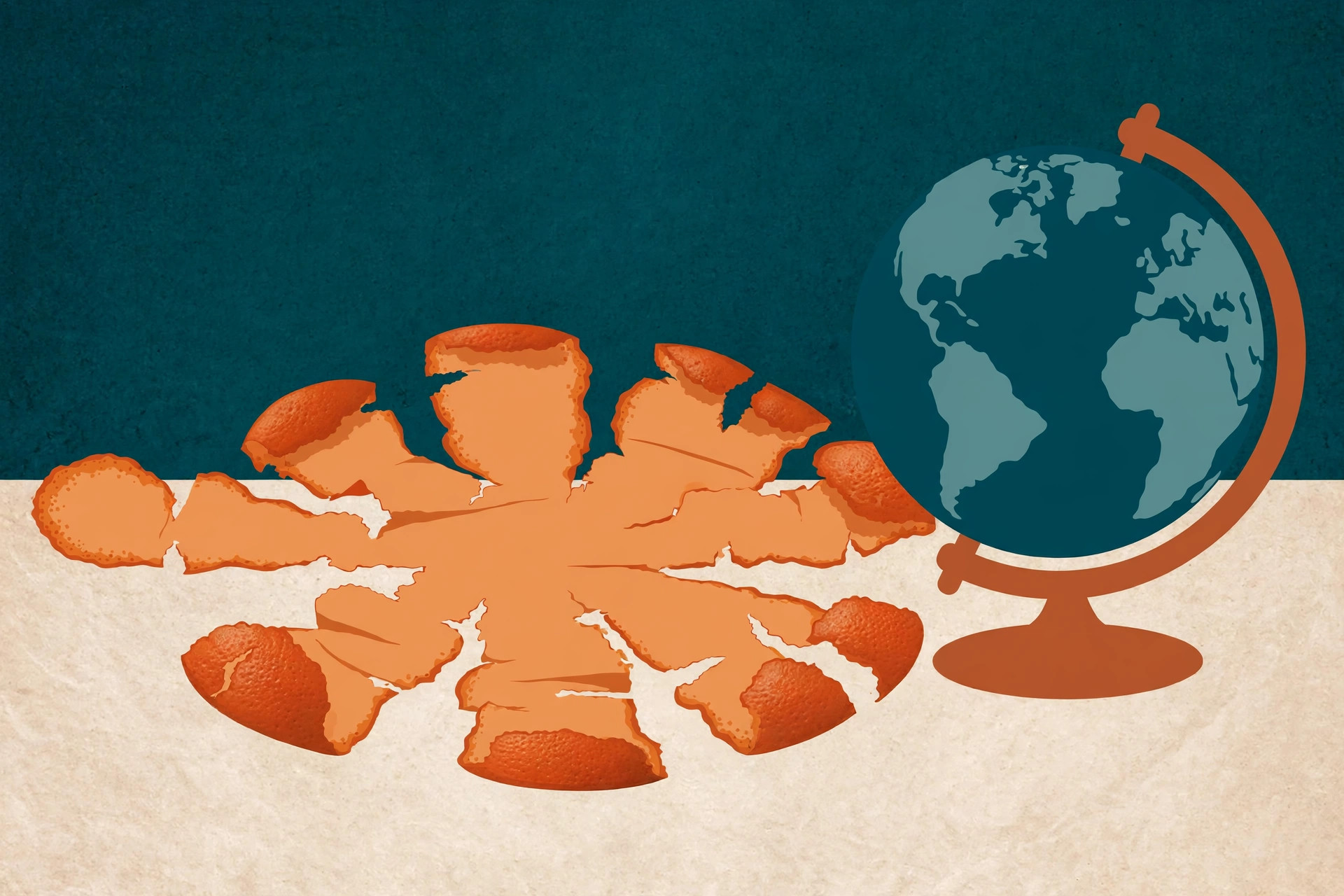
The impossible flattening
A globe is the only honest map. Peel the surface of a sphere onto a flat sheet and something must give: shapes stretch, areas swell, distances warp or directions bend, and usually several at once. A projection is simply a chosen pattern of giving. Mathematicians proved in the nineteenth century that no flat map can preserve everything, so cartography became the art of deciding which truth matters for the task at hand. Sailors needed true bearings, tax collectors needed true areas, and school atlases needed shapes that children would recognise, and each need produced its own family of maps.There is a neat parlour test for any wall map: compare the sizes it gives to countries you can check in an atlas table, and the projection will confess within a minute which truth it chose to keep.
Mercator and his bargain
The Mercator projection of 1569 keeps angles true, so a line of constant bearing crosses every meridian at the same angle and a navigator can steer by it. The price is area: land swells with latitude until Greenland rivals Africa, though Africa is in truth about fourteen times larger. The bargain was fair for its purpose, and Mercator never claimed otherwise. Trouble starts when a chart drawn for steering is hung on a classroom wall as a picture of the world, teaching generations a quietly wrong sense of the size of continents, a lesson the web era has been busy unlearning.School atlases compromise with interrupted and oval world maps that keep both areas and shapes roughly honest, at the price of oceans sliced or margins curved, a bargain most geographers accept gladly.
Other ways to be honest
Equal area projections, such as Gall Peters and Mollweide, keep every country its true size at the cost of stretching shapes. Conic projections suit mid latitude countries and are used for many national atlases. The azimuthal family shows true distances and directions from one chosen centre, handy for airline route maps centred on a hub. Modern web maps quietly cheat by reprojecting as you zoom. The mature conclusion is not that maps lie, but that each map answers one question well. Ask what a projection preserves before you trust what it shows.The honest habit is to ask of any map the question a lawyer asks a witness: what are you not telling me? Every projection answers that question in its fine print, if you know to look.