Parallels and Meridians: The Grid on the Globe
Two families of lines
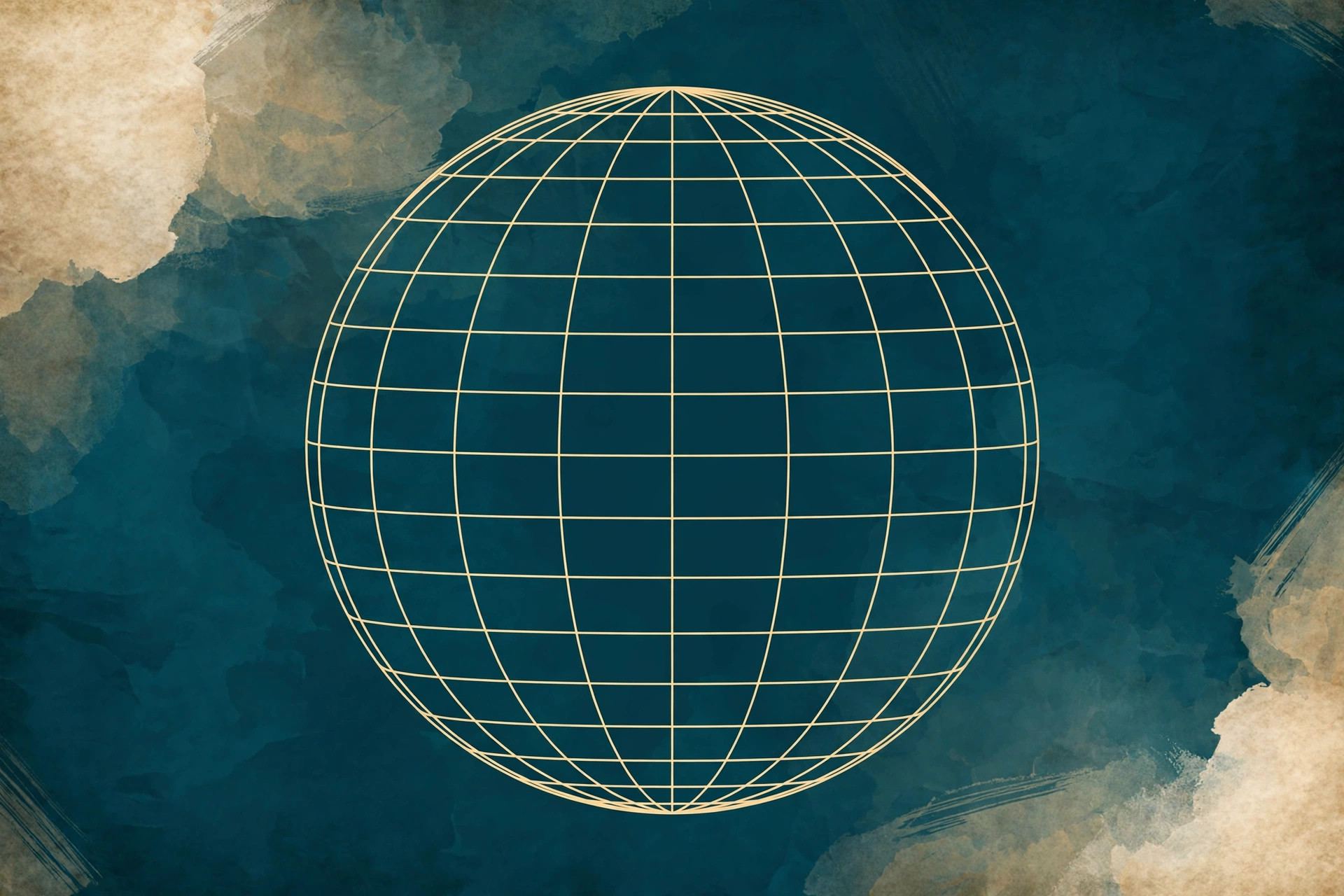
The grid drawn on globes is made of two families. Parallels of latitude run east and west, each a full circle parallel to the equator, and they never meet. Meridians of longitude run north and south, each a half circle from pole to pole, and they all meet at both poles. That one geometric fact explains most of the odd behaviour of coordinates. Distances along a parallel shrink as the parallel shrinks, while distances along a meridian stay almost constant, because every meridian is nearly the same length. A globe shows this honestly; a flat map cannot, which is the root of every projection argument.Parallels are lines of equal behaviour as well as equal angle: places sharing a parallel share the same day length pattern and the same noon sun height on any given date, which is why famous wine regions cluster on matching parallels in both hemispheres.
Special parallels with names
Some parallels earn names from astronomy. The tropics, at about 23.4 degrees north and south, mark where the sun can stand directly overhead, at the June and December solstices respectively. The polar circles, at about 66.6 degrees, mark where the sun can stay up, or stay down, for a full 24 hours. Between the tropics lies the zone where the sun passes overhead twice a year; outside the polar circles, day and night always take turns within a single day. These lines drift very slowly over thousands of years as the tilt of the Earth wobbles, so the tropic monuments by some roadsides are already a few metres out of date.The tilt that fixes the tropics is itself slowly changing, shrinking by tiny amounts over a cycle of about 41,000 years, so the lines our distant descendants inherit will sit a few hundred metres from the ones we use.
Meridians and the meaning of noon
A meridian is also a line of equal solar time: when the sun crosses your meridian, it is local noon for everyone on that line, north and south. Before railways, towns kept their own meridian time, and clocks in Bristol ran about ten minutes behind London because Bristol sits about 2.6 degrees further west. Standard time zones replaced that patchwork with agreed bands roughly 15 degrees wide, one hour each, but the sun still follows the meridians. The calculator for longitude time differences shows the pure solar version, which near zone borders can differ from the clock by a surprising amount.Greenwich won the zero, but every meridian is geometrically identical to every other; the grid would work just as well counted from Paris, Beijing or Quito, a reminder that coordinates are agreements laid over geometry.