Polar Day and Polar Night
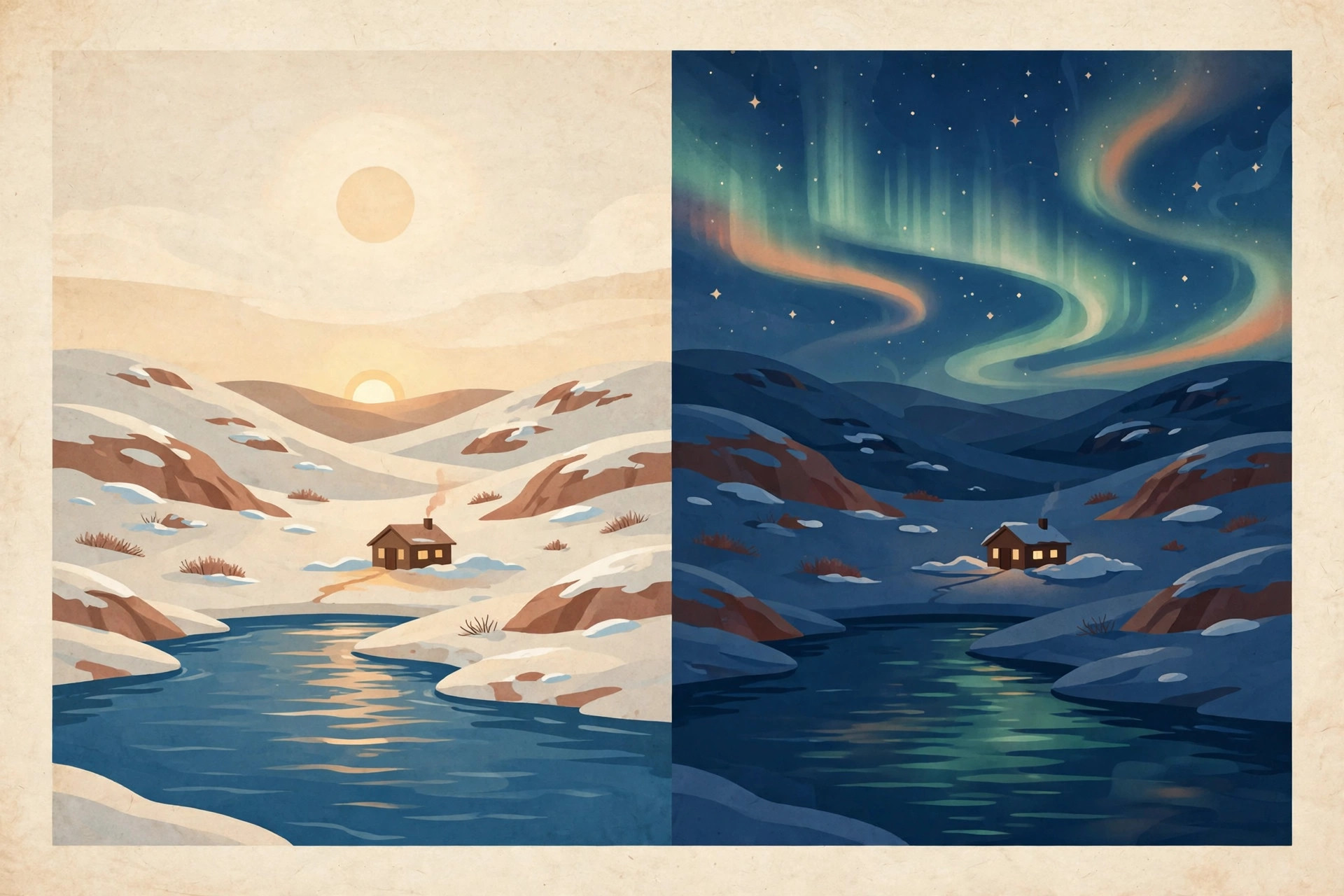
Where the sun forgets to set
Beyond the polar circles, at about 66.6 degrees north and south, there are days when the sun completes its whole circuit without dipping below the horizon. At the circles themselves the show lasts a single day at the solstice; at the poles it lasts half the year. Tromso in Norway, at nearly 70 degrees north, sees the sun continuously from mid May to late July. The light at midnight is golden and horizontal, shadows stretch to absurd lengths, and the body clock, deprived of its main signal, drifts until curtains and routine replace the missing night.Plants and animals adapt in their own ways: Arctic flowers track the circling sun like slow sundials, and reindeer abandon a daily rhythm altogether in midsummer, grazing in shifts around the clock.
The answering darkness
Winter returns the compliment. The same geometry that granted endless day takes the sun away entirely for a matching stretch, leaving polar night. It is not total darkness: for weeks either side there is a blue twilight at noon, and the sky offers compensations in the aurora, the moon riding high for days at a time, and stars at midday. People who live there plan around it with light, exercise and social rhythm, and rates of winter low mood are a serious public health topic. The sun calculator on this site reports polar day and polar night plainly rather than inventing times that do not exist.The phenomenon has a southern twin with almost no audience: outside the Antarctic circle live only researchers, a few thousand in summer and about a thousand through the long night.
Science at the extremes
The poles attract researchers precisely because the day cycle is removed. Telescopes at the South Pole can watch the same patch of sky for months; climate scientists drill ice that fell as snow under suns that never set. The Antarctic stations keep the time of their home ports, since local solar time is meaningless where every direction is north. For the rest of us the phenomenon is a reminder that day and night, the most basic rhythm of life, are local arrangements set by latitude, and that the map, once again, explains the experience.Travellers time cruises and expeditions by these windows, and the midnight sun has become a season in itself for the towns of the north, with festivals held at hours when the rest of the world sleeps.