Solar Noon and the Honest Sundial
Noon that will not sit still
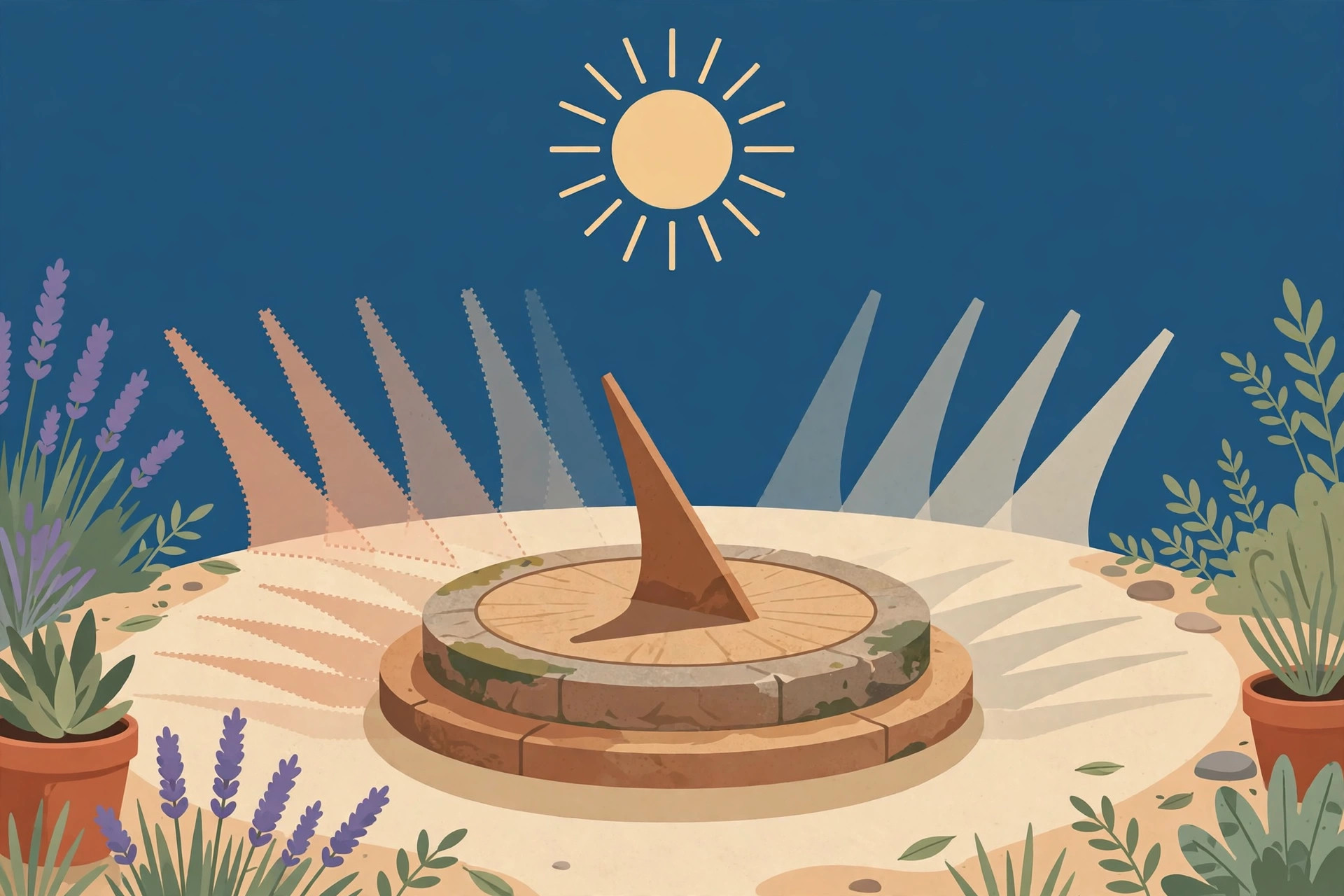
Clock noon is an average. Solar noon, the moment the sun reaches its highest point and crosses your meridian, wanders around it for two reasons. The first is longitude: within a time zone, only places on the standard meridian have solar noon near twelve; places at the western edge see it half an hour or more later by the clock. The second is the equation of time: the tilt of the axis and the elliptical orbit make the sun run fast or slow against the clock by up to about sixteen minutes through the year, ahead in November, behind in February.Garden dials make poor clocks and excellent teachers: set one true, and its disagreement with your phone through the year draws the equation of time on the paving stones.
Reading a sundial honestly
A sundial tells solar time, so it disagrees with your watch by the sum of those two effects, plus an hour in summer if your country shifts the clocks. Old dials often carry a table or a motto acknowledging the difference. To set a dial correctly you align it to true north, level it, and apply the corrections for the date; the shadow then reads the time the sky keeps, which for most of history was the only time there was. The sunrise calculator on this site reports solar noon in UTC, and comparing it with your local clock across the year traces the whole story.The two effects also explain why solar panels are rated and angled by simulation rather than by the clock, because the sun keeps apparent time, not the timetable on the wall.
The analemma, a year of noons
Photograph the sun at the same clock time every day for a year and the images form a tall figure eight in the sky, the analemma. Its height is the tilt of the Earth at work, its width is the equation of time. Globes often print it in the Pacific, and sundial makers engrave it to correct their instruments. It is the most elegant diagram in geography: one curve holding the orbit, the tilt and the calendar together, drawn by nothing more than patience and a fixed camera, or by plotting solar noon from a calculator through the seasons.Old railway posters sometimes boasted that the sun was their timekeeper; within a generation the same companies were printing correction tables, which is the whole history of timekeeping in one irony.