Sunrise, Sunset and the Length of the Day
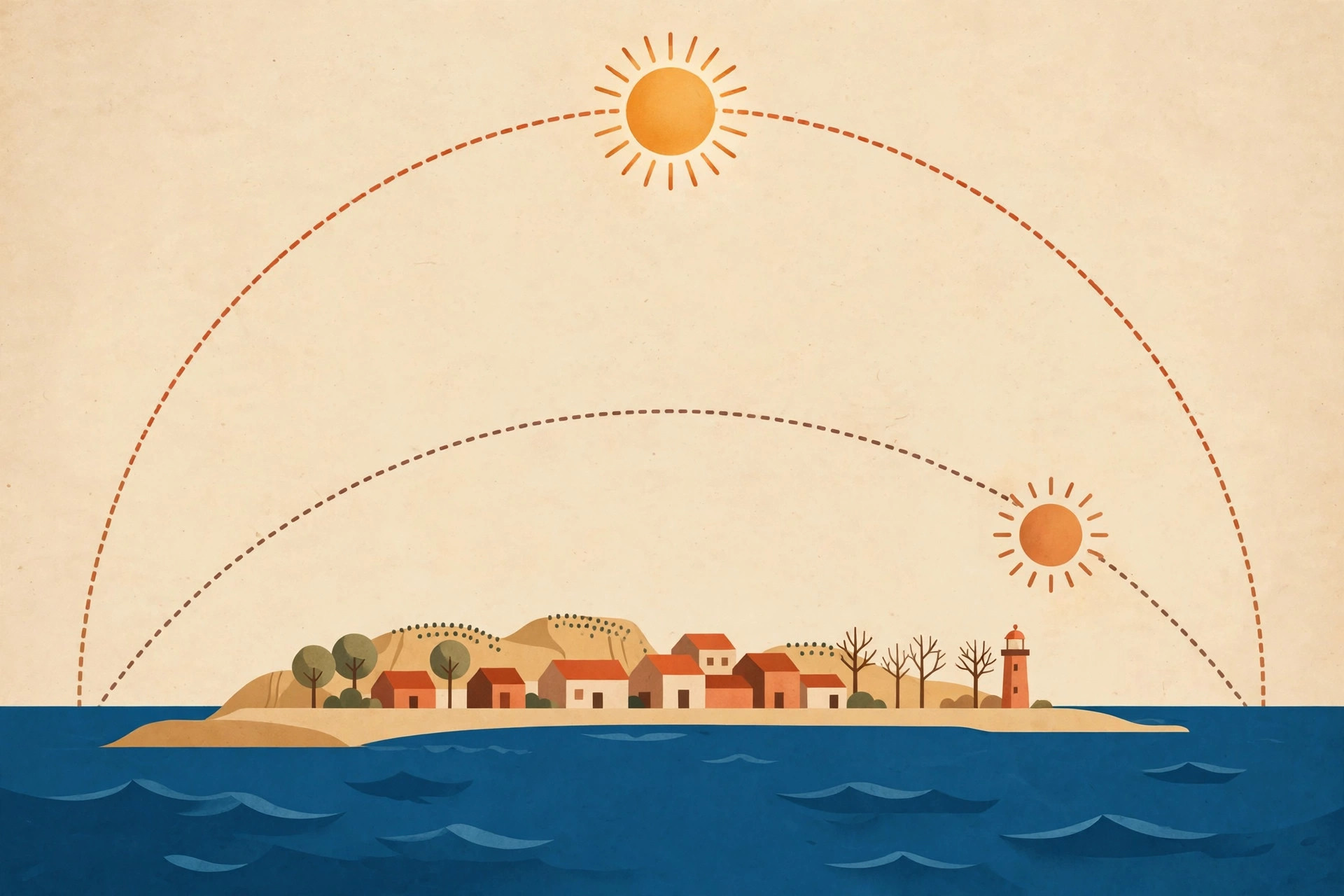
Tilt is the whole story
The Earth leans. Its axis tilts about 23.4 degrees to its orbit, so as the planet circles the sun, first one hemisphere then the other leans towards the light. When your hemisphere leans in, the sun climbs higher, rises earlier, sets later and the days stretch; lean away and everything reverses. At the equator the lean makes little difference, and day length stays near twelve hours all year. At the latitude of London the difference between the June and December solstices is about nine hours of daylight, and at the polar circles the effect runs to its limit, a full day with no sunset at all.The rate of change is a latitude story too: near the equator the day barely changes all year, while at high latitudes the spring gains arrive in great strides of several minutes a day.
Why the change speeds up and slows down
Day length does not change evenly. Around the equinoxes in March and September it races, gaining or losing three or four minutes a day at mid latitudes, because the sun is then moving fastest in its apparent north south journey. Near the solstices it stalls: the word solstice itself means the sun stands still, and for a fortnight around the longest day the sunrise time barely moves. Gardeners and photographers plan around this rhythm instinctively. The sunrise calculator shows it plainly if you step through the dates a week at a time and watch the day length breathe.Gardeners read the same numbers in reverse, counting the hours of light a plot receives in December to decide what will survive there, because winter day length, not summer, is the binding constraint.
Sunrise is a definition, not a moment
The official sunrise is the instant the top edge of the sun appears over a level horizon, not the centre, and the atmosphere bends light enough to lift the image of the sun by about half a degree, so we see it slightly before it geometrically arrives. Almanacs build both effects in, using a standard depression of the sun of 0.833 degrees below the horizon. Hills, buildings and sea mist rewrite the local version entirely. The NOAA method used on this site follows the almanac definition, which is why its figures match published tables within a minute or two for open horizons.If you compare the calculator with a newspaper table and find a minute of difference, you have met the rounding of horizons and refraction, the honest fuzz at the edge of an exact science.