Time Zones at Sea: The Nautical System
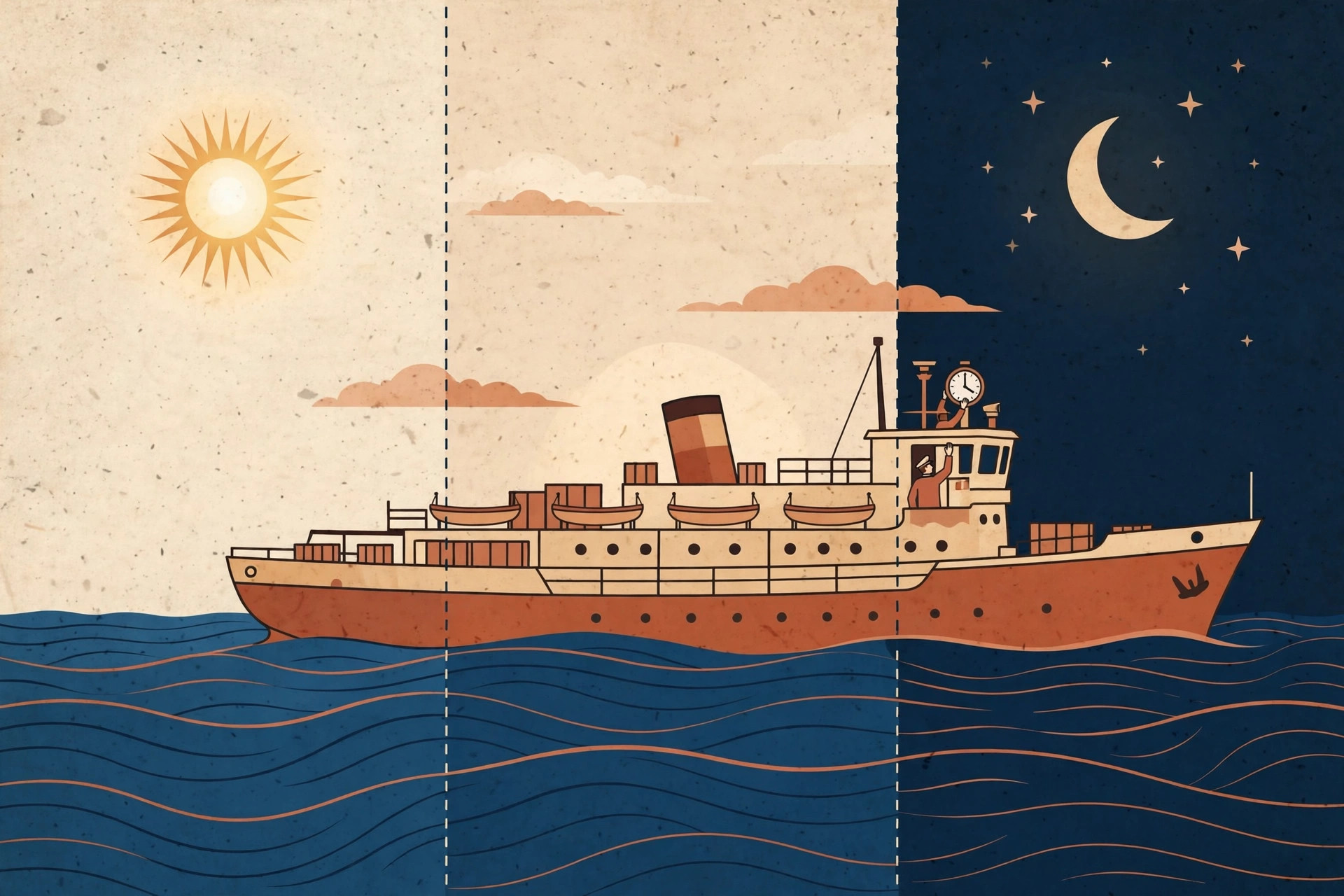
Time where there are no borders
At sea there are no mayors to please, so ships kept the rational system the land abandoned. Nautical time divides the oceans into zones fifteen degrees wide, centred on multiples of fifteen degrees of longitude, each a whole number of hours from Greenwich. A ship changes its clocks as it crosses a boundary, traditionally in steps during the night watches. The zone is described by a number and a sign rather than a name, and the letter Z, spoken as Zulu, stands for the Greenwich zone, which is why aviation and military messages stamp times in Zulu to this day.The ship day once began at noon rather than midnight, when the sun sight fixed the position, and nautical almanacs were printed accordingly, a trap that still catches readers of old logbooks. Port cities on zone boundaries once kept two clocks in the harbour office, one for the town and one for the ships, and harbourmasters became bilingual in time long before the phrase existed.
Why the sea kept it simple
A ship needs time for one overriding purpose: navigation. Star and sun sights are worked against the almanac in Greenwich time, and the ship clock is a convenience for meals and watches. Keeping zones geometric means the navigator always knows the rough conversion between local time and Greenwich from the longitude alone, one hour per fifteen degrees. Ports, of course, keep their own civil time, so a ship in harbour lives in two systems at once, the zone on the chart and the time ashore, and the gangway notice board states both to save arguments.Submarines and polar stations borrow the sea habit, adopting a single home time for the whole deployment because the local sky offers no useful day to follow.
The idea survives in the air
Aviation inherited the system wholesale. Flight plans, weather reports and clearances are all issued in UTC, called Zulu, whatever the local time at either end, because a flight may cross six zones before lunch. Passengers meet the system in the small print of timetables, which quote local times for humans while the operation runs on one clock underneath. The longitude time calculator on this site shows the geometric version, solar time from longitude, which is the sea system stripped to its essence and still the fastest way to sanity check any zone conversion.The letter zone names survive in the phonetic alphabet used on every radio: Zulu time is quite simply the time at zero longitude, spoken so it cannot be misheard.