Why India Keeps One Time Zone
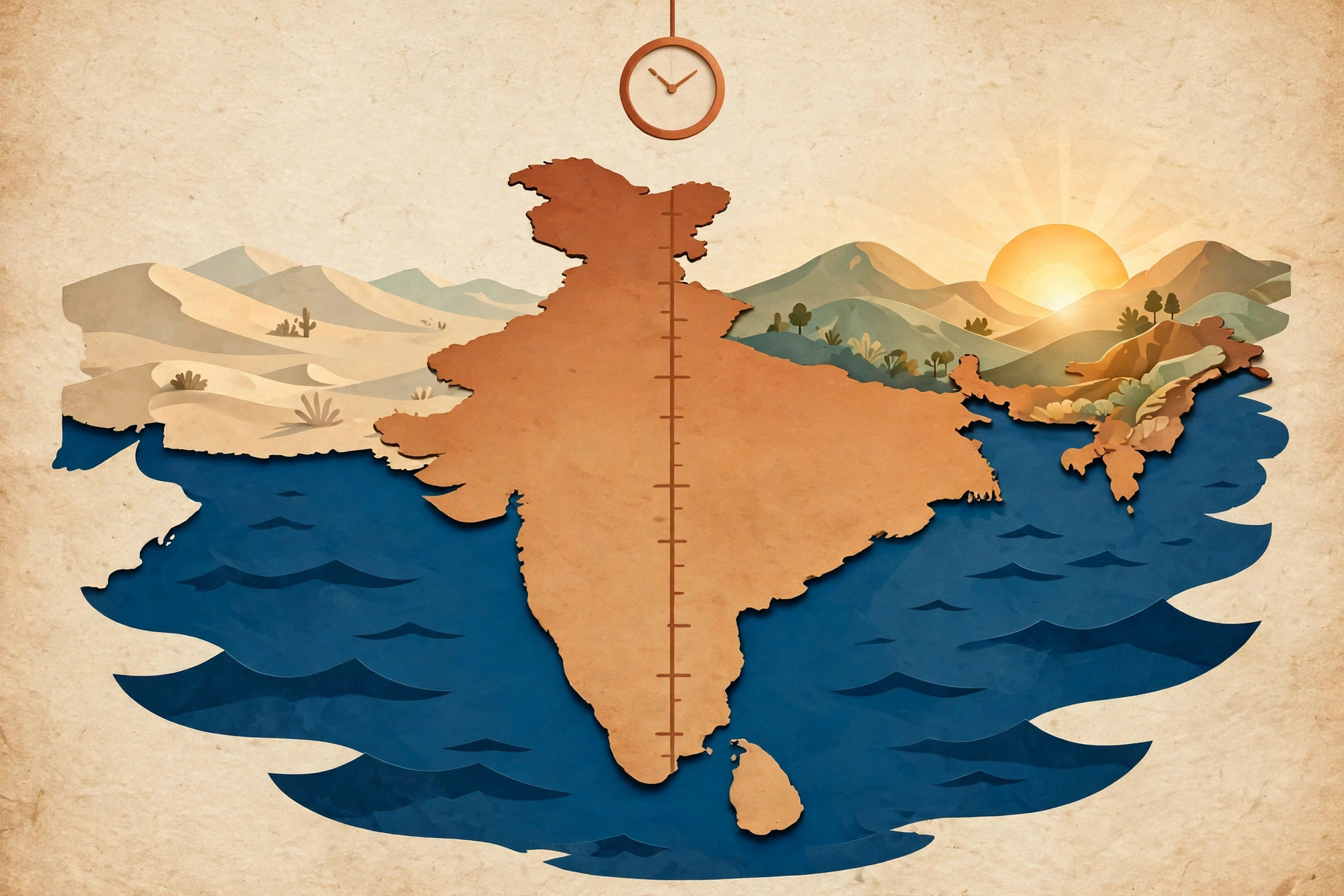
Eighty nine degrees on one clock
India stretches about 2,900 kilometres from Gujarat in the west to Arunachal Pradesh in the east, a span of roughly 29 degrees of longitude, which by the sky is nearly two hours of solar time. Yet the whole country keeps a single time, Indian Standard Time, five and a half hours ahead of UTC, set from the meridian of 82.5 degrees east, which passes near Prayagraj in the north. The half hour offset, unusual in a world of whole hours, is the fingerprint of a compromise: the meridian sits near the middle of the country, so neither edge is too far from its solar time.The standard meridian was chosen to pass near the old observatory site at Madras and the centre of the country, and the half hour step is shared with only a handful of other places worldwide.
A colonial inheritance kept by choice
Before independence, India ran on several times: Bombay time, Calcutta time, Madras time and railway time among them, a patchwork the railways found as maddening as Britain had. A single standard was adopted in 1906 for the railways and telegraphs, kept after 1947 as an emblem and instrument of unity, and formalised since. The choice was deliberate and remains debated. The north east, where the sun can rise near half past four in summer by the clock, has periodically asked for its own zone or for shifted working hours, and Assam tea gardens long kept their own informal garden time an hour ahead.Sri Lanka keeps the same time as India, while Nepal, next door, sits a quarter hour ahead of it, so three neighbouring countries demonstrate three different answers to the same sky.
What one time zone does to a day
A single clock across two hours of sky means the working day slides against the light. Offices in Mumbai start in bright morning; in the far east, winter evenings fall during the afternoon shift, and energy is spent lighting hours that a second zone would give free. Supporters answer with the simplicity of one national timetable for trains, markets, exams and broadcasts. The longitude calculator on this site shows the raw geometry: compare the solar gap between the two edges of India with the zero gap on their clocks, and the trade off becomes a number rather than an argument.Travellers feel the single zone most at dawn in the east, where markets open in what feels like the middle of the morning, and at dusk in the west, where the working day ends in broad light.